What AI Actually Replaced in Bookkeeping by 2026 - and What It Didn't
- By: Admin
Quick answer
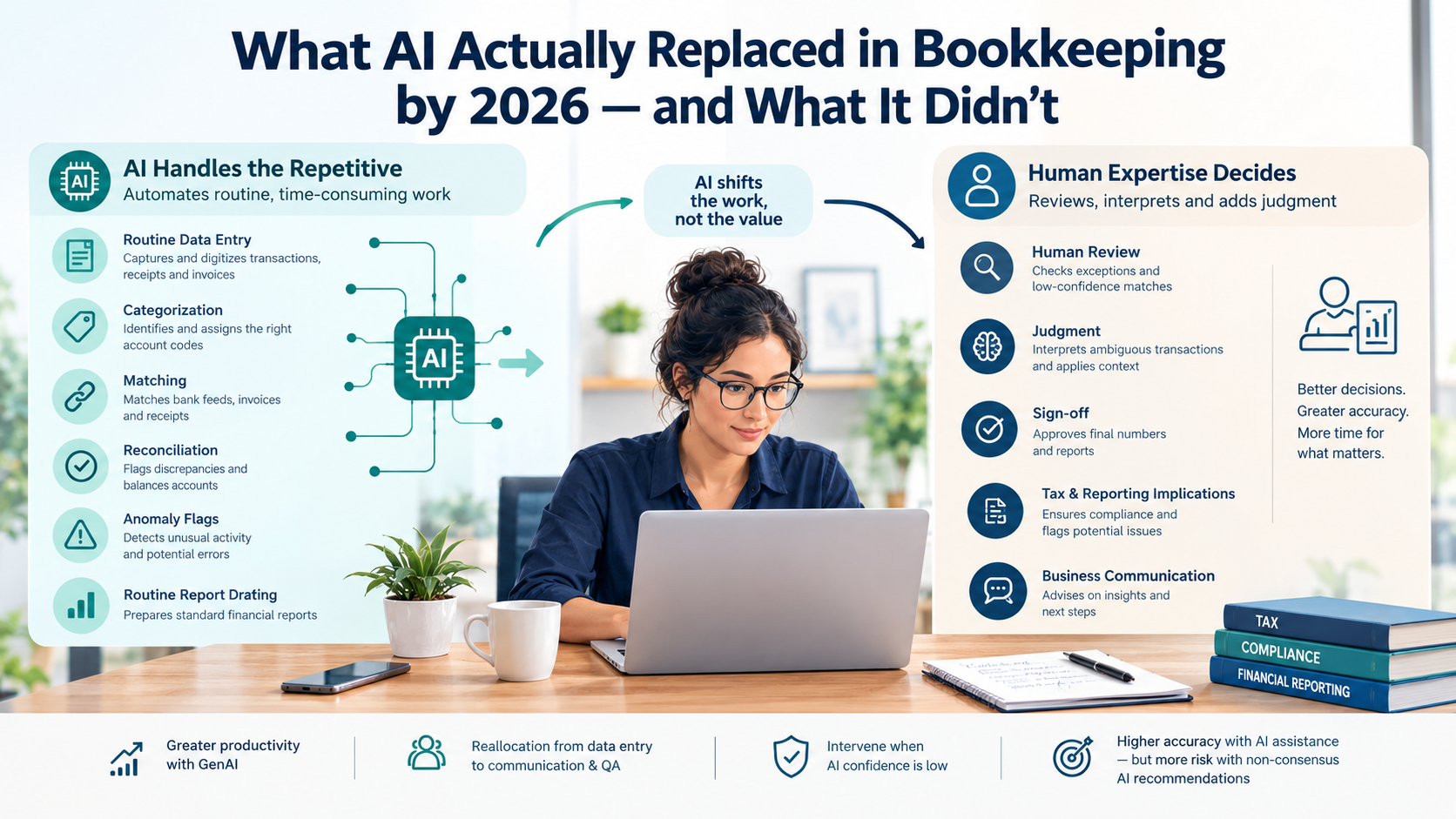
By 2026, AI has substantially automated transaction categorisation, receipt and invoice data capture, bank feed matching, and first-pass anomaly flagging. These tasks are now largely software-driven, with a human reviewing exceptions rather than performing the work directly.
AI has not reliably automated accrual judgement, revenue recognition analysis, multi-entity consolidation, GAAP treatment decisions, client communication and chasing, controller-level review, or anything requiring context the software was not given. These remain human work, and the businesses that assumed otherwise are, in most cases, the ones now searching for a bookkeeper to fix what the software missed.
The net effect has not been fewer accounting jobs. It has been a shift in what the job consists of - less data entry, more review, judgement and exception handling. The bottleneck in accounting was never typing speed. It has always been judgement, and judgement is the part that did not automate.
What actually got automated
Transaction categorisation
This is the clearest win. Bank feed transactions are now categorised automatically by machine-learning models trained on merchant data and historical coding patterns, with confidence scores attached. A well-tuned system correctly categorises the large majority of routine transactions without human involvement.
What this replaced: the manual keying of every bank line into a category, which used to consume a meaningful share of a bookkeeper's week.
What it did not replace: decisions on ambiguous transactions - a payment to a vendor who sometimes supplies inventory and sometimes supplies office equipment, or a transaction that is correctly categorised by merchant but wrongly capitalised versus expensed for the specific business. The software gets the easy 80% right and needs a human for the hard 20%, which happens to be where the errors that matter live.
Receipt and invoice capture
Optical character recognition combined with large language models now extracts vendor, amount, date and line items from receipts and invoices with high accuracy, including handwritten and low-quality scans that would have defeated older OCR systems.
What this replaced: manual data entry from paper and PDF documents, and much of the associated filing.
What it did not replace: matching an invoice to the correct purchase order and confirming goods or services were actually received - the control that prevents duplicate and fraudulent payment, which is a judgement and verification step, not a data extraction step.
Bank and credit card reconciliation matching
Software now auto-matches the large majority of bank feed transactions to book entries, flagging only the unmatched remainder for review.
What this replaced: the line-by-line manual matching that used to be the bulk of reconciliation time.
What it did not replace: investigating why an item does not match - a timing difference, a bank error, or a genuine bookkeeping mistake - which requires understanding the business, not just comparing two lists.
First-pass anomaly detection
Modern platforms flag unusual transactions: an amount outside historical pattern, a new vendor, a round-number payment, a transaction outside normal hours. This is now standard in leading accounting software and a core feature of AP fraud-prevention tools.
What this replaced: the purely manual scanning of transaction lists looking for something that "looks wrong," which was inconsistent even when done by an experienced person.
What it did not replace: deciding whether a flagged anomaly is actually a problem. A flagged $45,000 payment to a new vendor might be entirely legitimate - a new supplier relationship - or might be a business email compromise in progress. The software raises the flag. A person has to know the business well enough to resolve it, usually inside a tight time window.
Draft financial statement generation
AI-assisted platforms can now generate a first-draft P&L, balance sheet and basic variance commentary from categorised transaction data with minimal manual formatting.
What this replaced: the mechanical assembly of reports from the general ledger, and much of the formatting work that used to follow.
What it did not replace: deciding what the variance actually means, and writing commentary a CEO or board can act on. "Revenue increased 12%" is a calculation. "Revenue increased 12%, entirely driven by one customer renewing early, and underlying run-rate is flat" is judgement, and it requires knowing the business.
What did not automate - and why
Accrual and estimate judgement
Deciding whether a cost should be accrued, how much, and in which period, requires understanding the underlying transaction, not just its data. Should a legal invoice received in January be accrued in December because the work was performed then? Was a bonus probable and estimable at year end? These require knowledge that sits outside the transaction record - a conversation with operations, an understanding of a contract, awareness of a dispute.
AI can flag that an accrual pattern looks different from prior periods. It cannot determine, from the data alone, what the correct accrual is.
Revenue recognition analysis
Under ASC 606, revenue recognition depends on contract terms, performance obligations, and judgement calls about standalone selling price and variable consideration. A software-as-a-service company with usage-based pricing, minimum commitments and mid-term upgrades needs a human to read the actual contract and apply judgement - the software cannot infer contract terms it was never given, and even when fed a machine-readable contract, the judgement calls around probability and materiality remain human calls.
Multi-entity consolidation
Consolidating multiple legal entities involves intercompany eliminations, currency translation, minority interest calculations, and - critically - deciding how to treat unusual intercompany transactions. Software handles the mechanical elimination once the treatment is decided. Deciding the treatment, especially for a transaction that does not fit the standard pattern, remains human.
GAAP and internal control judgement
Whether a lease is a finance lease or an operating lease under the current standard, whether a cost should be capitalised or expensed, whether a control gap is material - these are professional judgement calls informed by the specific facts. AI tools can surface the relevant guidance faster than a manual search could. They do not make the determination.
Client and stakeholder communication
Explaining a variance to a CEO, negotiating a payment plan with a struggling vendor, chasing an overdue client invoice in a way that preserves the relationship - none of this is a data problem. It requires reading a person, adjusting tone, and making a judgement call about how hard to push. Automated dunning emails exist and are useful for the first two reminders. The call that actually gets a stuck invoice paid is still a human call.
Controller-level review
Someone still has to look at the fully processed set of books and ask whether it makes sense as a whole - whether the story the numbers tell matches what actually happened in the business this month. This is pattern recognition built on experience and context that a transaction-level tool does not have visibility into. It is also the review step that catches the errors every other automated step missed.
Anything the software was not told
This is the general case behind every item above. AI systems work from the data they are given. A verbal agreement with a customer, a side letter changing contract terms, a conversation where a vendor agreed to a credit that has not yet been invoiced - none of this exists in the transaction data, and no model can account for information it was never given. A human embedded in the business, talking to the people who make these agreements, is the only way this information reaches the books at all.
What this means in practice for a business
The realistic shape of a modern bookkeeping and accounting function in 2026 is not "software replaced the team." It is a team whose composition shifted:
- Less time on manual categorisation, data entry and routine matching.
- More time on exception review, judgement calls, accrual and estimate decisions, and communication.
- A different skill mix - the value has shifted from data-entry speed toward accounting judgement and the ability to work efficiently inside AI-assisted tools rather than around them.
This has two direct consequences for a business deciding how to resource its accounting function.
First, cost has fallen for the automated tasks but not for the judgement tasks, which means the case for outsourcing has shifted rather than disappeared. If your only need were categorisation, that argument has weakened - much of it is now genuinely self-service. But almost no business's need is only categorisation. The close, the review, the judgement calls and the communication remain labour-intensive, and that is exactly the work outsourcing addresses.
Second, the risk of under-resourcing accounting has gone up, not down. A business that concluded "AI handles the books now" and cut its accounting support to near zero is often the business that discovers, eighteen months later, that nobody was reviewing the categorisation exceptions, nobody caught the accrual that should have been booked, and nobody flagged the anomaly that AP fraud tools correctly surfaced but nobody acted on. Automation without review is not automation. It is an unsupervised process, and unsupervised processes drift.
How to evaluate an accounting provider on this specifically
Ask any provider - including us - these three questions, and be wary of a provider who cannot answer them concretely.
- Which parts of our engagement will be software-driven, and which will be human judgement? A specific, task-by-task answer indicates the provider actually understands their own workflow. A vague answer about "leveraging AI and automation" usually indicates marketing language standing in for a real process.
- What does your exception review process look like? Every automated categorisation and matching system produces exceptions. Ask how they are surfaced, who reviews them, and how quickly.
- What happens when the software gets something wrong? Every system does, eventually. The answer should describe a specific control - a monthly reconciliation of categorisation accuracy, a review sample, a named person accountable for catching drift - not a general assurance that "it's very accurate."
The honest conclusion
AI did not replace bookkeeping. It replaced the parts of bookkeeping that were purely mechanical, and it did that quickly and well. What is left is the part that was always the actual job: knowing when something is wrong, understanding why, and making a judgement call that the data alone cannot make.
That is not a smaller job than it used to be. For most growing businesses, it is a more valuable one, because the mechanical work that used to consume the week is now available for review, analysis and the conversations that actually change outcomes.
Frequently asked questions
Has AI replaced bookkeepers? No, not in the sense of eliminating the role. AI has automated specific mechanical tasks - transaction categorisation, receipt data capture, and routine reconciliation matching - while judgement-based work such as accrual decisions, revenue recognition analysis, and review remains human. Most bookkeeping roles have shifted toward exception handling and review rather than disappearing.
What accounting tasks can AI do reliably in 2026? Transaction categorisation from bank feeds, OCR-based data extraction from receipts and invoices, automated matching in bank reconciliation, first-pass anomaly flagging in AP, and generation of draft financial statement formatting. All of these still benefit from human review of exceptions and edge cases.
What accounting tasks still require a human? Accrual and estimate judgement, revenue recognition analysis under ASC 606, multi-entity consolidation decisions, GAAP treatment calls such as lease classification, client and vendor communication, and controller-level review of the full financial picture. These require context and judgement that is not present in transaction-level data alone.
Can I run my bookkeeping entirely on AI software without a person reviewing it? Not safely for an ongoing business. Every automated categorisation and matching system produces exceptions and edge cases that require a human decision. Running fully unsupervised risks accrual errors, missed anomalies, and drift in categorisation accuracy that compounds over time before anyone notices.
Will AI eventually replace accountants entirely? Current systems automate mechanical, pattern-based tasks well. The tasks that remain - contextual judgement, communication, and integrating information that exists outside the transaction record - have not shown the same rate of automation and depend on information that is not systematically captured in the data these tools are trained on.
Should outsourced bookkeeping cost less now because of AI? The mechanical component of the cost has fallen, and pricing across the industry reflects that. But the judgement, review and communication components - which make up most of the value in a well-run engagement - have not been automated, so the overall cost has not fallen proportionally to the automation of data entry alone.
Staunch Fintech uses automated categorisation, OCR capture and anomaly flagging as the starting point for every engagement, not the end point - every account is reviewed by a named accountant who knows your business. If you want to see where the line sits on your own books, send us a recent bank feed and we will show you what the software catches and what still needs a person.