Outsourced Controller vs Fractional CFO vs Full-Time Hire: Scope and Cost Compared
- By: Admin
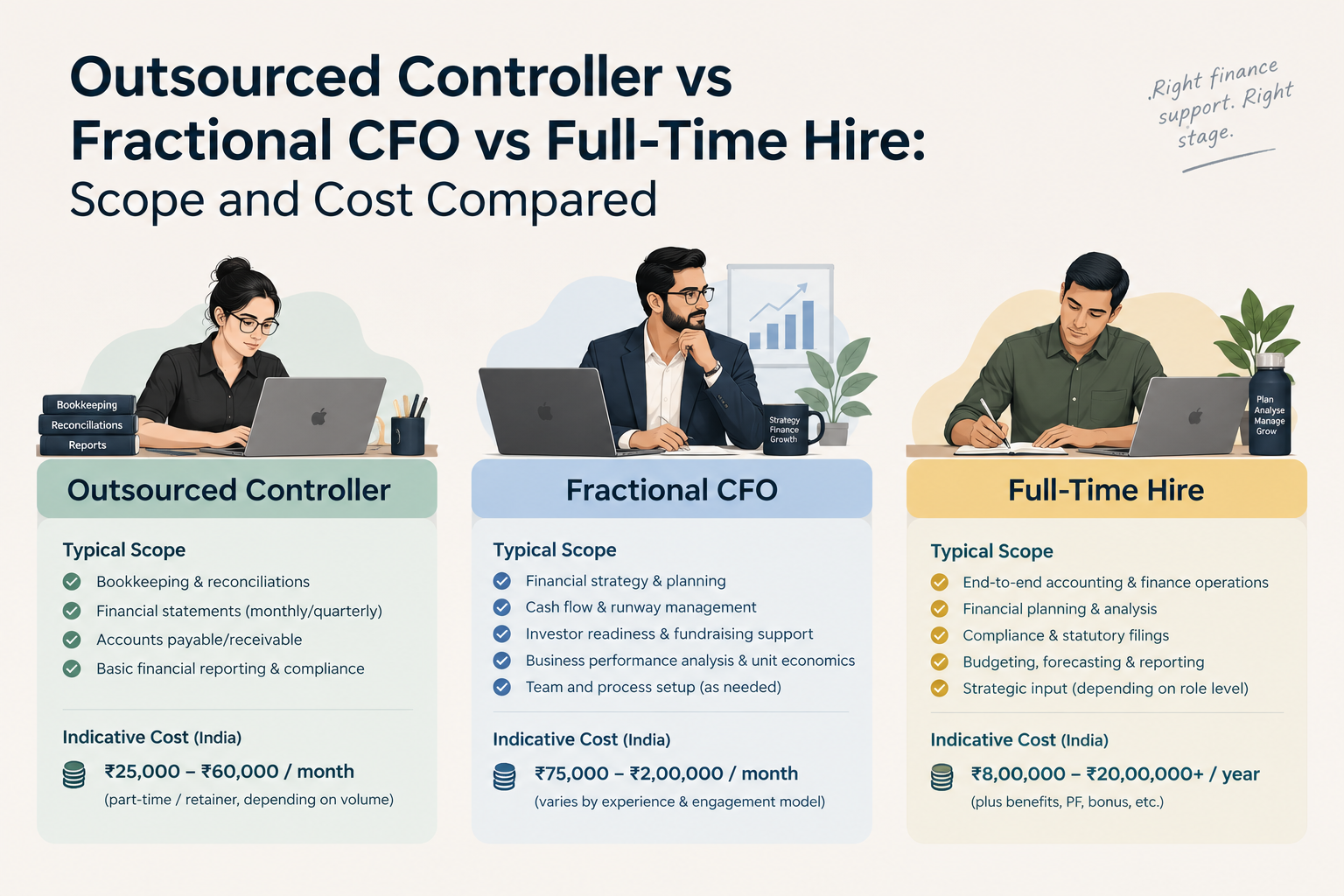
Somewhere between $3M and $10M in revenue, most businesses arrive at the same conclusion: the bookkeeper is no longer enough. The books close eventually, but the numbers arrive too late to act on, nobody can explain why margin moved, and the bank has started asking for covenant calculations that take three days to produce.
At that point the founder or CEO usually starts recruiting for a CFO. That is frequently the wrong move, and it is an expensive one to reverse.
This guide separates what a controller does from what a CFO does, prices all four ways of getting each, and gives you a decision framework based on what is actually broken rather than what job title sounds most senior.
Quick answer
A controller owns the accuracy and timeliness of your financial records - the close, the reconciliations, GAAP treatment, internal controls, and the reporting pack. A CFO owns what you do with those numbers - forecasting, capital structure, pricing strategy, lender and investor relationships, and board reporting.
In 2026, a full-time US controller costs roughly $162,000–$201,000 fully loaded, a full-time CFO $260,000–$450,000. An outsourced controller runs $2,500–$6,000 per month onshore or $4,500–$6,500 per month for a dedicated offshore controller. A fractional CFO typically costs $3,000–$10,000 per month on retainer, or $200–$400 per hour onshore.
The most common expensive mistake is hiring a CFO to fix a controller problem. If your issue is that the close takes twenty days and you do not trust the numbers, a CFO cannot help you. Fix the foundation first.
The distinction that saves the most money
|
Function |
Controller |
CFO |
|
Orientation |
Backward - what happened |
Forward - what will happen |
|
Owns the month-end close |
Yes |
No |
|
Reconciliations and GAAP treatment |
Yes |
No |
|
Internal controls and segregation of duties |
Yes |
Oversight only |
|
Audit preparation and liaison |
Yes |
Oversight only |
|
Management reporting pack production |
Yes |
Defines what it should contain |
|
Budget and forecast model |
Prepares inputs |
Owns |
|
Cash flow forecasting and runway |
13-week mechanics |
Strategy and decisions |
|
Pricing and margin strategy |
Supplies the data |
Owns |
|
Banking, debt and covenant negotiation |
Calculates compliance |
Negotiates |
|
Fundraising and investor relations |
Supports diligence |
Leads |
|
Board and lender presentation |
Prepares materials |
Presents |
|
M&A |
Diligence support |
Leads |
Read the middle column. If most of what you need sits there, you need a controller. Paying CFO rates for controller work is the single most common overspend in mid-market finance.
What each option costs in 2026
|
Option |
Typical cost |
Time commitment |
Best when |
|
Full-time US controller |
$125k–$155k base; $162k–$201k fully loaded |
40 hrs/week |
Revenue above roughly $20M, or complex multi-entity operations requiring daily presence |
|
Outsourced controller (US-based) |
$2,500–$6,000/month |
20–60 hrs/month |
$5M–$20M revenue, predictable needs, want US-hours availability |
|
Dedicated offshore controller |
$4,500–$6,500/month, or $30–$60/hour |
Full-time or contracted block |
Want controller-level capability at 60–70% less than a US hire; comfortable with a time-shifted workflow |
|
Full-time CFO |
$200k–$350k base plus bonus and equity; $260k–$450k fully loaded |
40 hrs/week |
Revenue above roughly $50M, active M&A, or institutional capital requiring a full-time finance leader |
|
Fractional CFO |
$3,000–$10,000/month retainer, or $200–$400/hour |
10–40 hrs/month |
$5M–$50M revenue, or a defined event: a raise, a refinancing, a sale |
Fully loaded figures apply a 1.3x multiplier to base for payroll taxes, benefits and overhead. CFO loading is higher where equity is granted.
Choose by what is broken, not by revenue
Revenue bands are a rough guide. The better test is which of these statements describes your situation.
You need a controller if:
- Your month-end close takes more than ten business days.
- You do not fully trust the numbers you are looking at.
- Reconciliations are behind, or done inconsistently.
- You have had audit adjustments, restatements or a qualified opinion.
- Your reporting pack is a P&L export rather than a management report.
- You have added entities, states or currencies and the accounting has not kept up.
- One person can both create a vendor and release a payment.
You need a CFO if:
- Your close is reliable but nobody translates the numbers into decisions.
- You are raising capital, refinancing, or preparing for sale within twelve months.
- You cannot confidently state your runway or your unit economics.
- Pricing decisions are made on instinct.
- You have a board or institutional lender expecting a forward view.
- You are evaluating an acquisition.
You probably need both - sequenced
The correct order is almost always controller first, CFO second. A CFO working from unreliable data produces confident forecasts that are wrong, which is worse than no forecast. Firms that sequence it the other way round typically spend six months and a six-figure salary discovering they needed a controller.
The hybrid model most mid-market firms land on
The arrangement that works for a large share of $5M–$30M businesses is neither of the pure options:
A dedicated offshore controller handling the close, reconciliations, GAAP treatment and reporting production - paired with a fractional CFO onshore for eight to twenty hours a month of strategy, board and lender work.
The economics are straightforward. Offshore controller at $5,500 per month plus fractional CFO at $5,000 per month totals roughly $126,000 per year for both functions. A single full-time US controller alone costs more than that, and does not give you the CFO capability at all.
The reason it works is that the two roles have different sensitivities to location. Controller work is process-heavy, documentation-driven and benefits from the overnight time-zone offset - work performed while you sleep, reviewed when you start. CFO work is relationship-heavy: it involves sitting in a board meeting, talking to your banker, negotiating with a buyer. That is harder to time-shift and often better done onshore.
Where the hybrid fails: if nobody owns the handoff. The controller must produce a reporting pack the CFO can work from without rebuilding it. Define that pack and its deadline explicitly, or you will pay CFO rates for data cleanup.
How these engagements are actually structured
Outsourced or offshore controller
Usually a monthly retainer against a defined close calendar and deliverable set. A sound scope specifies:
- Close completion by a stated business day (day 5, day 8, day 10)
- Named reconciliations performed monthly
- A defined management reporting pack with fixed contents
- Variance commentary against budget
- Ownership of the audit PBC list
- Escalation thresholds - what gets flagged to you rather than decided
Anything not named in that list will not happen. Be specific.
Fractional CFO
Usually a monthly retainer with an hours ceiling, or project-based for a defined event. Structure around outcomes rather than hours:
- Rolling 13-week cash forecast, updated weekly
- Annual budget and quarterly reforecast
- Monthly board or lender package with narrative
- Named strategic projects per quarter
- Attendance at defined meetings
Watch for: retainer creep where the CFO absorbs controller work because the close is not reliable. This is the most common way a fractional CFO engagement becomes poor value. Fix the close.
What each option cannot do
An offshore controller cannot sit in your Tuesday leadership meeting, walk the warehouse floor to understand an inventory discrepancy, or build the internal relationships that surface problems before they hit the ledger. They also cannot sign filings requiring a US-licensed professional.
A fractional CFO cannot be the person your team escalates to on a Wednesday afternoon at 4pm. Ten to twenty hours a month buys direction, not availability.
A full-time hire cannot be scaled down. If the need turns out to be twenty hours a month, you have bought a fixed cost you will carry for years, and a difficult conversation to end it.
None of them can substitute for accurate underlying bookkeeping. Every option above degrades to expensive data cleanup if the transactional layer is broken.
When to convert to full-time
Reasonable triggers for bringing a controller in-house:
- Sustained revenue above roughly $20M–$25M
- More than five legal entities, or meaningful international operations
- A finance team of four or more requiring day-to-day management
- Daily operational involvement - inventory, project accounting, field operations
- A lender or investor requiring a full-time named finance leader
For a CFO, the trigger is usually institutional: a priced funding round, an acquisition programme, or preparation for a sale process where the buyer expects a full-time counterparty.
Below those thresholds, the fixed cost rarely pays for itself.
Four red flags when evaluating providers
- A CFO proposal that does not ask about your close. Anyone selling forward-looking strategy without first establishing whether your historical numbers are reliable is selling you something you cannot use.
- Scope described in hours rather than deliverables. "20 hours of controller support" is not a scope. A close calendar and a named deliverable list is.
- No named individual. These are judgement roles. A rotating pool is acceptable for transaction processing and unacceptable here.
- Unwillingness to define what triggers escalation to you. You need to know in advance which decisions come to you and which do not.
Frequently asked questions
What is the difference between a controller and a CFO? A controller owns the accuracy and timeliness of financial records - the close, reconciliations, GAAP compliance, internal controls and reporting production. A CFO owns the forward view - forecasting, capital structure, pricing strategy, and relationships with lenders, investors and the board. The controller reports what happened; the CFO decides what to do about it.
How much does an outsourced controller cost per month? US-based outsourced controllers typically cost $2,500 to $6,000 per month depending on hours and complexity. A dedicated offshore controller costs $4,500 to $6,500 per month on a full-time basis, or $30 to $60 per hour for contracted blocks.
How much does a fractional CFO cost? Between $3,000 and $10,000 per month on retainer, or $200 to $400 per hour for US-based fractional CFOs. Project-based engagements around a fundraise or sale are commonly quoted as a fixed fee.
At what revenue should a company hire a full-time CFO? Most businesses do not need a full-time CFO below roughly $50M in revenue unless a specific trigger applies - institutional investors requiring one, an active acquisition programme, or preparation for a sale. Below that, a fractional CFO usually delivers the same capability at a fraction of the cost.
Should I hire a controller or a CFO first? A controller, in almost all cases. A CFO working from unreliable financial data produces forecasts and strategy built on a faulty base. If your close is slow or your numbers are not trusted, that is a controller problem and hiring a CFO will not solve it.
Can a controller be offshore? Yes. Controller work is process-driven, documentation-heavy and benefits from the overnight time-zone offset, which makes it well suited to an offshore dedicated resource. The limits are physical presence, day-to-day operational involvement, and anything requiring a US professional licence.
What is the cheapest way to get both controller and CFO capability? A dedicated offshore controller handling the close and reporting, paired with an onshore fractional CFO for strategy and stakeholder-facing work. The combination typically costs less than a single full-time US controller while covering both functions.
Staunch Fintech provides controller and CFO consultant support alongside the underlying bookkeeping, AP, AR and management reporting - which means the close and the reporting pack are built by the same team, not stitched together across vendors. Tell us how long your close currently takes and what your board or lender is asking for, and we will scope what level you actually need.