QX vs MYCPE ONE vs Initor Global vs Staunch Fintech: An Honest Comparison for US CPA Firms (2026)
- By: Admin
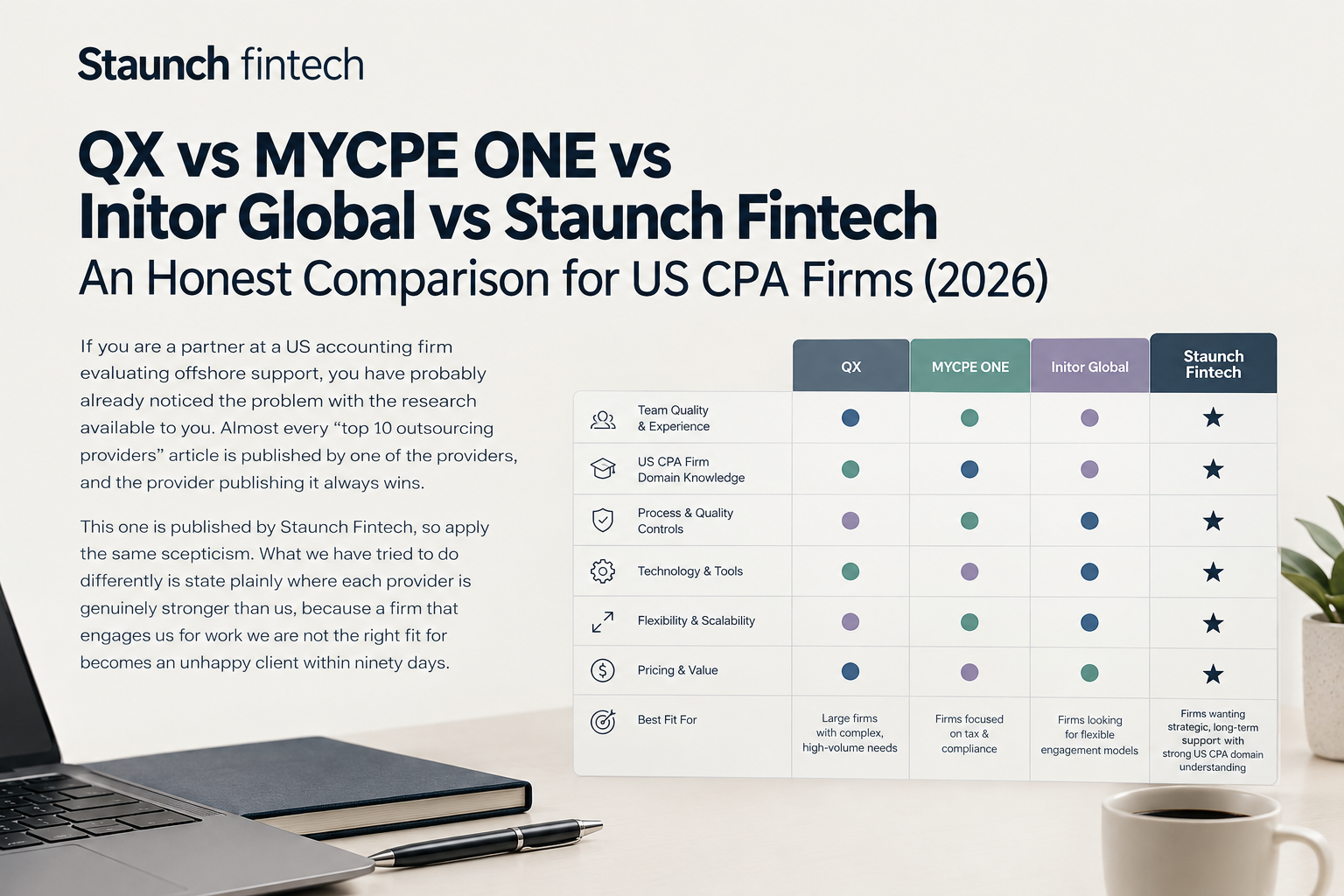
Quick answer: which provider fits which firm
MYCPE ONE is the best fit for mid-to-large firms that want an ecosystem - offshore staffing plus CPE, recruitment and eventually their own captive entity. QX Accounting Services suits firms that need to scale a sizeable offshore team quickly inside a structured, process-heavy delivery environment, particularly those with UK exposure as well as US. Initor Global works well for small and mid-sized firms whose primary pain is tax-season capacity. Staunch Fintech fits firms under roughly forty people that want a small, named, directly accessible team across accounting, tax and back-office work rather than a large managed programme.
If you need twenty-five trained staff onboarded inside a month, go to QX or MYCPE ONE. We cannot do that, and we will tell you so on the first call.
Why comparison is difficult in this market
Three structural problems make like-for-like comparison harder than it should be.
Pricing is mostly hidden. Very few providers publish rates. Those who do tend to publish a single headline number that applies only to the most junior role. Entigrity historically marketed offshore staff starting around $11 per hour; QX bookkeeping resources are commonly cited at roughly $1,500 to $2,000 per month per full-time person. Both numbers are real, and both describe a starting point rather than what most firms end up paying.
"Outsourcing" describes at least four different products. Staff augmentation, managed services, white-label delivery and build-operate-transfer captives are sold under the same word and priced on entirely different logic. Comparing an hourly staff-augmentation rate against a managed-service monthly fee tells you nothing.
Scale is presented as quality. A provider with 1,200 accountants is not automatically better than one with 60. It is better at some things - surge capacity, redundancy, certification budgets - and worse at others, notably how much attention a twelve-person firm receives.
The four providers compared
|
MYCPE ONE |
QX Accounting Services |
Initor Global |
Staunch Fintech |
|
|
Base |
Sugar Land, Texas + Ahmedabad, India |
Ahmedabad, India (part of QX Global Group) |
India, UK-registered presence |
Odisha, India |
|
Formed |
2024, from the Entigrity–MYCPE merger |
Long-established, part of a larger BPO group |
Established mid-2010s |
Newer entrant |
|
Primary buyer |
CPA and accounting firms, small through large |
Accounting firms and mid-market businesses, US and UK |
Small to mid-sized CPA and bookkeeping practices |
SMBs and small-to-mid CPA firms |
|
Core model |
Staff augmentation, managed services, and Build-Operate-Transfer captives |
Dedicated staffing and managed outsourcing |
Dedicated and per-return outsourcing |
Dedicated FTE, part-time, hourly, project |
|
Scale signal |
Works with 3,000+ accounting firms |
800+ accounting firm clients; 1,200+ accountants |
Mid-sized delivery footprint |
Boutique |
|
Beyond accounting |
CPE, exam prep, M&A advisory, US recruitment, digital marketing, managed IT |
Automation and process consulting, recruitment |
Focused on accounting and tax |
IT back-office support, software migration |
|
Published pricing |
Minimum engagements commonly quoted from $10,000; hourly generally under $25 |
Roughly $1,500–$2,000/month per full-time bookkeeper |
Not published |
Four models, quoted per engagement |
Figures above reflect publicly available information as of 2026. Verify current terms directly with each provider - rate cards and models change.
MYCPE ONE
Formed in late 2024 when Entigrity merged with the CPE platform MYCPE, this is now the broadest offering in the category. In April 2026 it launched a Build-Operate-Transfer model aimed at firms that want to eventually own their offshore entity outright, charging a flat management fee covering entity incorporation, HR, payroll, IT and hiring rather than billing per head.
Genuine strengths. The ecosystem argument is real. If you are already buying CPE, considering an acquisition, and struggling to hire domestically, consolidating those with your offshore provider reduces vendor management. The BOT path is the most credible route available to a firm that wants a captive without building one alone. Client retention figures cited by Entigrity historically sat in the mid-nineties.
Where firms find friction. Minimum engagement sizes are meaningful - commonly $10,000 and upward - which prices out very small practices. And the breadth that is an advantage for a 200-person firm can feel like being sold to when you are a four-partner shop that just wants two bookkeepers.
Choose them if: you are above roughly thirty staff, you are thinking in terms of a multi-year offshore strategy rather than a season, and the captive endgame appeals.
QX Accounting Services
Part of QX Global Group, operating from Ahmedabad, serving both US and UK accounting firms across bookkeeping, tax, payroll and audit support.
Genuine strengths. Scale and process maturity. If you need to go from zero to fifteen people, QX can do it and has done it repeatedly. Their dual US–UK presence is valuable if you serve clients with UK subsidiaries - very few India-based providers can handle both regimes competently. Documented delivery processes and structured quality control are a real advantage for firms that do not have spare partner time to supervise.
Where firms find friction. Structure cuts both ways. Firms report that the experience is programme-managed rather than personal, and that changing scope mid-engagement moves at the pace of a process rather than a conversation. Small firms sometimes feel they are not the priority account.
Choose them if: you need volume, speed of ramp, or UK capability alongside US work.
Initor Global
A more focused proposition aimed squarely at accounting practices managing seasonal peaks, particularly US tax season.
Genuine strengths. Tax-season capacity is a specific problem and Initor is built around it. Firms that need to absorb a January-to-April surge without year-round headcount are a natural fit. Client retention in the segment is reportedly strong, which in this market usually indicates the delivery actually works.
Where firms find friction. A narrower service footprint than QX or MYCPE ONE. If your requirement extends into CFO-level advisory, complex multi-entity consolidation or non-accounting back office, you will be adding vendors.
Choose them if: your constraint is seasonal return volume rather than year-round capacity.
Staunch Fintech
We are the smallest provider on this list, operating from India across outsourced accounting and bookkeeping, tax return preparation, AP and AR, management reporting, controller and CFO support, accounting software migration and IT back-office services.
What we do well. You deal with the people doing the work, not an account management layer. We price on four models - dedicated full-time, part-time, hourly and project - which means you can buy sixty hours a month if that is genuinely what you need, rather than being pushed to a full FTE. Our service range extends past accounting into software migration and IT support, which matters to firms that are simultaneously trying to get off QuickBooks Desktop and clear a bookkeeping backlog.
Where we are not the right answer. We cannot match QX or MYCPE ONE on ramp speed. We do not offer a captive or Build-Operate-Transfer model. Our brand recognition in the US market is limited compared with providers who have spent a decade at AICPA and state society events. If your evaluation criteria include "how many of my peers have heard of them," we will score poorly.
Choose us if: you want a small named team, flexible commitment levels, and direct access to the people preparing your work.
What actually matters more than the provider name
After the shortlist is built, the variables that determine whether an engagement succeeds are consistent regardless of which logo you pick.
- Who reviews the work. Establish whether a senior reviews before it reaches you, or whether you are the first reviewer. This single answer explains most quality complaints in this industry.
- Named resource and qualification. Ask who will do your work, what their qualification is, and how many other accounts they carry.
- Escalation path. When something is wrong at 9pm your time, who do you contact and what is the response commitment?
- Security posture. Ask for the specifics: SOC 2 or ISO 27001 status, whether work is done on virtual desktops, whether USB and email exfiltration are blocked, and how the provider complies with IRS Publication 4557 expectations.
- Section 7216 handling. If tax return data is going offshore, your client consent obligations under IRC Section 7216 are yours, not the provider's. A good partner will help you get the disclosure language right; none of them can discharge the duty for you.
- Exit terms. Notice period, data return format, transition support. Providers who resist putting this in writing are telling you something.
Run a pilot before you commit
Whichever provider you shortlist, do not sign an annual agreement first. Run a defined pilot: three to five real client files, a fixed scope, a fixed fee, and measurable criteria - turnaround time, number of review points raised, and how many of your own hours the work consumed.
Firms that pilot properly rarely regret the provider they choose. Firms that select on a sales call and a rate card frequently do.
Frequently asked questions
Which offshore accounting provider is best for a small CPA firm? For firms under about twenty staff, smaller providers such as Staunch Fintech or Initor Global are usually a better fit than MYCPE ONE or QX, because minimum engagement sizes are lower and you retain direct access to the delivery team. Larger providers become advantageous above roughly thirty staff, where ramp speed and redundancy matter more than personal attention.
What is the difference between staff augmentation and managed services? Staff augmentation places a named offshore person inside your workflow; you direct and review their work. Managed services hand an entire function to the provider against an output specification; they direct the work and deliver a result. Augmentation gives more control and requires more of your supervision time. Managed services require less supervision and give less control.
How much does offshore accounting cost for a CPA firm in 2026? Broadly $10 to $25 per hour for preparation-level work and $30 to $60 per hour for controller-level work. On a dedicated basis, $1,400 to $2,400 per month for a bookkeeper and $2,400 to $3,800 for a tax preparer. Large providers often apply minimum engagement values of $10,000 or more.
Is it legal for a US CPA firm to send tax returns offshore? Yes, provided the firm obtains written client consent that satisfies IRC Section 7216 and Treasury Regulation 301.7216-3 before disclosing return information to an offshore preparer. The firm also remains responsible under its professional standards for the work product and for safeguarding client data.
Should I choose a provider based in India or the Philippines? India offers a deeper pool of qualified accountants with US GAAP and US tax exposure, and a larger CA-qualified population. The Philippines is often preferred where spoken-English client interaction is central, such as AR collections calls. For preparation and close work, India is the more common choice.
How long does it take to onboard an offshore accounting team? A single dedicated resource typically takes two to four weeks from agreement to productive work. A team of ten or more takes six to twelve weeks with a well-resourced provider, longer with a boutique. Add time if your software stack is unusual or your documentation is thin.
If you are shortlisting providers, we are happy to be on the list and equally happy to tell you when we are not the right answer. Send us three sample files and your current turnaround expectations, and we will come back with a scoped pilot and an honest view of fit.